
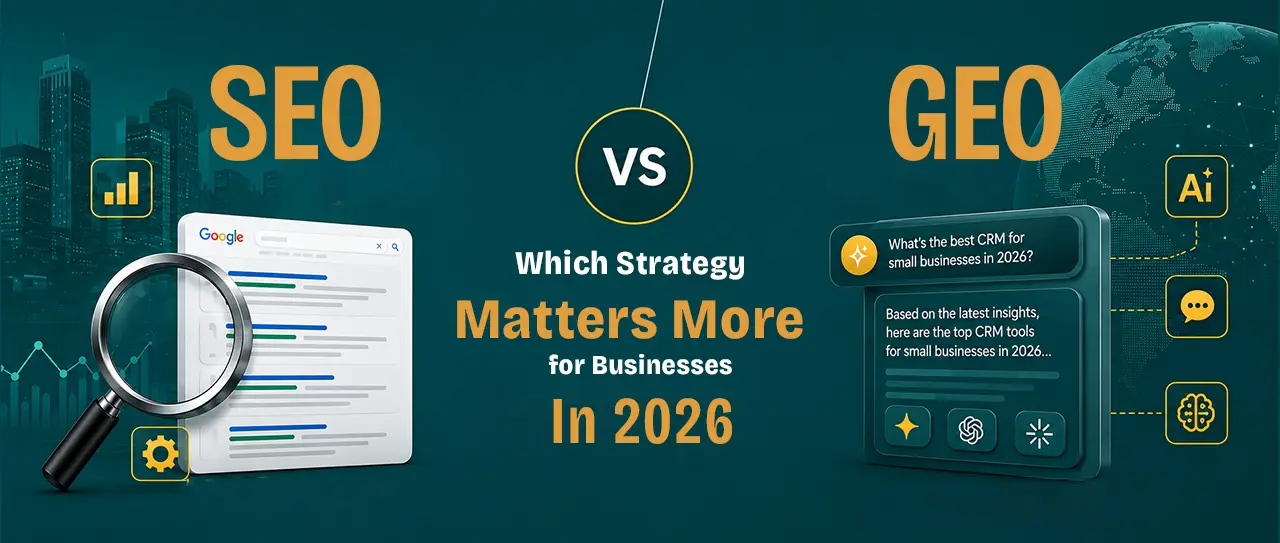
What drives online searches keeps shifting fast. Though Google stays the top choice, new AI-based services like ChatGPT, Google AI Overviews, Gemini, or Perplexity gain ground by offering swift, natural responses. A quiet reshaping unfolds in how companies show up where people look. Old methods of optimizing web content for search still matter, yet another approach – called Generative Engine Optimization – slowly rises because more eyes turn to AI-shaped query outputs.
Understanding the difference between SEO and GEO isn't about picking a favourite – it's more like linking two legs of the same stool that help companies be found on various search engines and artificial intelligence-powered tools. In this guide, we look at their main differences, why they matter, and how businesses can use both to strengthen their digital presence in 2026.
What Is SEO?
Are you a business owner or an upcoming entrepreneur? One of the first things you probably want is for people to find your business when they're searching for what you offer. That's where SEO comes in.
Search Engine Optimization (SEO) is the process of improving your website so search engines like Google can understand it, trust it, and show it to people looking for relevant information, products, or services. The goal isn't simply to rank for a keyword – it's to attract the right audience, earn organic visibility, and turn that visibility into meaningful business growth.
For example, if you run a digital marketing agency and someone searches “digital marketing agency in Delhi,” SEO helps your website compete for visibility when that potential client is actively looking for your services.
What goes into SEO?
- Search intent: Understanding what the user actually wants to find.
- Content quality: Creating useful, original content that answers real questions.
- Keywords: Using relevant search terms naturally within the content.
- Technical SEO: Improving crawling, indexing, site structure, speed, and performance.
- Backlinks: Earning relevant links that strengthen your website's authority.
- User experience: Making the website easy to navigate and useful once someone lands on it.
What Is GEO?
Imagine a potential customer no longer searching for a list of websites, but asking a detailed question and expecting one clear, useful answer. Generative Engine Optimization (GEO) is about making your brand and content strong enough to be understood, trusted, and considered within these AI-generated responses.
Unlike traditional SEO, where the focus is largely on improving a webpage's position in search results, GEO looks at how your information is represented within an answer. That means creating content with real expertise, clear context, reliable information, and useful answers rather than simply adding more keywords.
What does GEO focus on?
- AI visibility: Increasing the chances of your brand being recognised in relevant generated answers.
- Citations: Building content that can be supported and referenced as a credible source.
- Topical authority: Showing genuine expertise rather than covering a topic superficially.
- Clear context: Making it easy to understand what your business does and what it knows.
- Answer quality: Providing specific, useful information that directly addresses user questions.
- Zero-click discovery: Reaching users even when their search journey ends with an answer rather than a website visit.
GEO vs SEO: What's the Difference?
The basic difference is where you want your brand to appear. SEO helps your website appear higher in traditional search results like Google and Bing. GEO helps your brand and content become more visible in AI-generated answers from platforms like ChatGPT, Gemini, and Perplexity.
For example, if someone searches for “best marketing agency in Delhi” on Google, SEO helps your website compete for a position on the results page. If they ask ChatGPT the same question, GEO focuses on making your brand credible and relevant enough to potentially be mentioned or cited in the AI's answer.
| SEO | GEO | |
|---|---|---|
| Main Goal | Improve website rankings | Improve visibility in AI answers |
| Where It Works | Google, Bing and traditional search engines | ChatGPT, Gemini, Perplexity and AI search |
| Primary Focus | Keywords, backlinks, technical SEO and user experience | Context, authority, relevance and clear information |
| User Experience | Users browse search results and choose a website | Users receive a direct AI-generated answer |
| Content Strategy | Create content around search intent and relevant keywords | Create content that AI can understand, trust and reference |
| Example | Your website ranks for “best marketing agency in Delhi” | Your agency gets mentioned when someone asks AI for marketing agencies in Delhi |
| Key Metrics | Rankings, clicks, traffic and impressions | Mentions, citations, visibility and AI referrals |
| Long-Term Purpose | Build organic search visibility | Build visibility across AI-powered search |
Why Businesses Need Both SEO and GEO
How people find businesses is shifting. Instead of typing queries into search bars, some tap into chatbots like ChatGPT and Gemini where no result page is needed. This mix means old debates about ranking in listings vs location-focused ads no longer hold all the weight. Traffic from targeted areas still flows toward sites earning organic presence. Meanwhile, adjusting messages for AI-powered searches improves visibility within answer boxes. Working together, these pieces let a business show up at different points along a customer's path through online discovery.
What do businesses gain from using both?
- Reach different search behaviours: Connect with users who prefer traditional searches as well as those asking AI platforms direct questions.
- Build stronger visibility: Your business can have multiple opportunities to appear during the same customer's research journey.
- Strengthen content value: Content created with clear information, expertise, and genuine usefulness can serve both search engines and AI systems.
- Stay adaptable: Search technology will continue to change, so combining SEO and GEO gives businesses a more flexible digital strategy.
- Support brand recognition: Being visible across different search experiences can help customers become familiar with your brand before making a decision.
How SEO and GEO Work Together
SEO and GEO complement one another. They operate in different segments of the customer journey. SEO elevates your business across traditional search; GEO, meanwhile, makes it easier for algorithms to understand your business, potentially featuring it in AI-generated answers.
Take a marketing agency that publishes a detailed guide titled “How to Build a Social Media Strategy for a Startup.” Great SEO might get that page to rank when someone searches for it. But if the article has logical flow, supports its claims with solid evidence, and reveals deeper knowledge on the subject, it doesn't just inform humans – it also stands ready to help AI-powered systems when they produce answers.
Where they overlap
- High-quality content: Both benefit from content created for real users rather than search engines alone.
- Topical authority: Covering a subject thoroughly helps establish expertise and relevance.
- Clear structure: Well-organised headings, concise answers, and useful information make content easier to understand.
- Trust: Reliable information, credible sources, and a strong online reputation matter across both search experiences.
- User intent: Understanding what people actually want to know remains central to both strategies.
How Businesses Can Optimise for GEO
GEO starts with one simple idea: create content that is genuinely useful, credible, and easy to understand. Businesses should focus less on writing for algorithms and more on demonstrating real expertise, answering customer questions clearly, and giving AI-powered search enough context to understand their brand and content.
5 key practices
- Answer real questions: Address specific problems your audience is actually searching for.
- Build topical authority: Create meaningful depth around the subjects your business specialises in.
- Show genuine expertise: Add original insights, research, examples, data, or expert perspectives.
- Strengthen credibility: Use reliable sources and support important claims with evidence.
- Structure content clearly: Use logical headings, concise answers, lists, and well-organised information.
The Future of Search: SEO + GEO
Search is evolving, but the goal remains the same: help the right customer discover your brand at the right moment. SEO continues to build visibility through traditional search, while GEO is becoming important as more people turn to AI-powered platforms for direct answers and recommendations.
Flash Communications understands that staying visible today requires more than relying on one channel. From SEO and content marketing to social media, performance marketing, influencer marketing, PR, and digital strategy, we build solutions around how audiences actually discover and engage with brands. Our work across brands such as McDonald's, Eicher, Studex, and Alive Wellness reflects this approach.
The future isn't about choosing SEO or GEO. It's about building a strong digital presence that can adapt as search continues to change.
Want to make your brand more discoverable in 2026 and beyond? Connect with Flash Communications and build a strategy that's ready for the next generation of search.